


Almost 30 suspected scammers have been arrested and 3.7 million online profiles and accounts removed as part of a National Crime Agency-hosted crackdown against fraud perpetrated from across Africa.
The arrests, which took place primarily in Ghana and Nigeria, came as more than 100 people from overseas law enforcement agencies and tech companies gathered in London to participate in an operational intensification targeting crime groups operating across Africa and the infrastructure that they use to target victims in the UK and beyond.
It is the fourth such initiative of its kind with key law enforcement partners from 15 different agencies participating, and the first one hosted by the NCA, with participants including representatives from West African law enforcement alongside those from the Five Eyes Law Enforcement Group (FELEG).
Officers from such organisations as the FBI, Nigeria Police Force and Ghanaian Cyber Security Authority were joined by industry representatives from 15 companies including Meta, Microsoft and Google.
The in-person event took place between 6 and 9 October, with operational activity taking place both during the week and in the run up to these dates. The operations included focus on fraudsters based in West African countries, including Ghana and Nigeria, who use social media profiles to target victims of a number of fraud types, including investment and impersonation fraud.
Report Fraud worked with Meta to provide data to identify fraud enablers and the NCA and other law enforcement agencies worked closely with industry to help locate the suspects behind the scams leading to their arrests.
Meta also played a key role in coordinating the event and encouraging broad private sector participation to maximize scam compound disruption.
Over 1,110 West African Facebook and Instagram accounts that were associated with the data provided by Report Fraud were disabled, whilst over 490 Facebook accounts and over 490 ad accounts identified by OCC Data Enforcement were disabled. OCC Data Domain Enforcement identified and disabled over 380 scam domains that were assessed to potentially be associated with the scam domains provided by the OCC.
Money from the Home Office’s Integrated Security Fund was used to pay for the event.
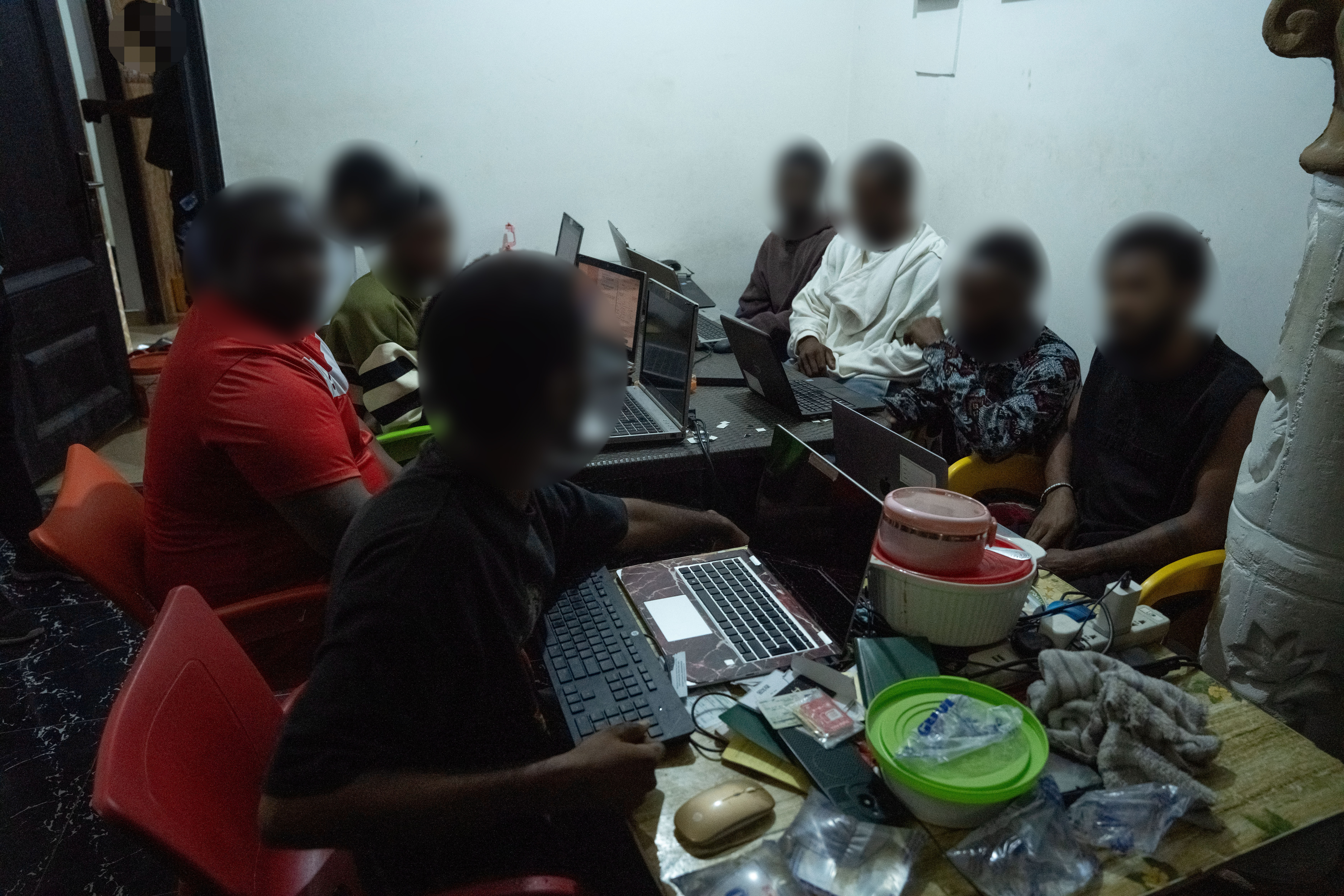
Nineteen people were arrested and 303 electronic devices seized in Sasaabi, Accra region of Ghana, during the week itself with 117 people identified as victims of trafficking pending return to Nigeria.
Nine people were arrested across the Delta State in Nigeria with six laptops, 35 phones and 12 routers seized.
Ghanaian law enforcement also led strikes on suspected scam centres in the same location at the end of last month, which led to multiple arrests and a number of victims of trafficking identified. Many of these were found to have been victims after being taken into custody, having suspected of being coerced into criminal activity. Police also seized 85 phones and 44 laptops.
This was a multi-agency operation led by the Ghana Cyber Security Authority, supported by the NCA, Ghana Police Service, FBI, and the Economic and Financial Crimes Commission in Nigeria.
The crackdown also saw 3.7 million online profiles and accounts removed by Meta and a total of $11 million dollars in potential freezable funds were identified by the private sector partners.
Nick Sharp, Deputy Director of Fraud at the National Crime Agency, said:
"Fraud is a global problem and it takes partnership working across international boundaries to tackle it. Hosting such a rich and dedicated team of law enforcement and technology companies at NCA’s headquarters enabled us to utilise the power of partnerships and strike back at a significant set of criminals who inflict misery on thousands of victims of fraud.
"Fraudsters can operate from anywhere and will target victims both domestically and globally. The NCA will continue to work with international and private sector partners to tackle fraudsters working upstream, overseas and online.
“Collaborating in this way sends a clear signal to criminals that the combined capabilities of law enforcement and industry means that we will relentlessly pursue them and the infrastructure they rely on no matter where they operate.”
Chris Sonderby, VP and Deputy General Counsel, Meta, said:
"Scams are a global threat that demand a global response. Last week, working with the UK National Crime Agency, the FBI, DOJ, and the Homeland Security Task Force, we took the fight to scam centers across West Africa.
“As part of the disruption, we removed more than 3.7 million accounts, Pages and Groups targeting people in the US, UK and beyond, and shared leads on over 30 suspected scam centers resulting in dozens of arrests, the rescue of trafficking victims, and cryptocurrency seizures.
“This operation shows what partnership makes possible, and we'll keep working with law enforcement and industry to pursue scammers wherever they operate."
FBI Director Kash Patel said:
“Thanks to brilliant partnership with the Department of Justice and the private sector, across multiple African countries, we arrested dozens of criminal actors, seized hundreds of devices, identified at least $11 million in potentially freezable funds, and truly saved lives.
“This is what happens when law enforcement executes with precision across the interagency. We are demolishing Scam Centers across the globe and crushing a criminal industry preying on American citizens.”
Assistant Attorney General A. Tysen Duva, of the U.S. Department of Justice’s Criminal Division, said:
“Criminals beware: Law enforcement from around the world are working together, and with private industry, to find you, stop your schemes, and bring you to justice.
“The Criminal Division’s Cyber-Enabled Scam Initiative (CSI) was built for this brand of collaboration. The millions of bogus social media accounts taken down and dozens of arrests that took place as part of Joint Disruption Week are just the beginning. I want to thank the UK’s National Crime Agency (NCA) and its Director General, Graeme Biggar, for hosting this effort, as well as everyone who participated. I am especially grateful to the courageous law enforcement officers in Ghana and Nigeria who put themselves in harm’s way to seize evidence and arrest the criminals who prey on innocent people.”
U.S. Attorney Jeanine Ferris Pirro, for the District of Columbia and founder of the Scam Center Strike Force, said:
“Transnational fraud demands a transnational response.
“I have partnered with the NCA and the Crown Prosecutor for England and Wales to push forward cases on both sides of the Atlantic; criminals are not hindered by borders and neither are we. We will deploy our team wherever in the world transnational criminals target innocent victims.”
Lord Hanson, Minister for Fraud, said:
"Criminal gangs operating overseas are behind most of the scams targeting the British public. That is why these multi-agency operations are critical, and my thanks go to all the officers involved in intercepting and arresting these scammers.
"Our new Online Crime Centre will build on this work to dismantle criminal networks and bring offenders to justice, wherever in the world they might be."
Chief Superintendent Amanda Wolf, Head of Report Fraud Operations, said:
“This joint operation shows why every report counts and the important role the public plays in helping us build the intelligence picture to stop fraudsters in their tracks.
“Working collaboratively, by sharing information from Report Fraud data with partners and law enforcement agencies, helps us all take down social media accounts that enable fraud and is vital in the fight against fraud.”
Look out for the warning signs of investment fraud:
- Online adverts promising guaranteed returns or low-risk investments
- Endorsements from celebrities or well-known figures
- Being asked to communicate over instant messaging and social media services
- Invitations to join an exclusive investment group
- Being instructed not to tell family or friends about your investment
- Requests for “tax”, release fees or verification fees before withdrawing any funds
- Ongoing pressure to invest
Anyone who thinks they may have been a victim should report this to Report Fraud at https://www.reportfraud.police.uk/
13 October 2026


