


With special thanks to our partners who have provided staff to the NECC:
Contents
Foreword from Steve Rodhouse, Director General Threats
This has been an important year for the National Economic Crime Centre (NECC) as we continue to strengthen the UK’s collective response to economic crime. I am hugely grateful to my predecessor, James Babbage, for the progress made under his leadership and the strong foundation he leaves. Building on this, our focus over the coming year will be to deepen partnerships, scale innovative capabilities, and deliver greater system-wide impact against economic crime.
Serious and organised crime is overwhelmingly driven by profit, and economic crime sits at the heart of that threat. It enables criminals to move, hide and enjoy the proceeds of their offending, while causing profound harm to individuals, communities, businesses and the UK economy. Left unchecked, economic crime undermines the UK’s competitiveness, security and global reputation.
The UK remains an attractive location for laundering the proceeds of crime, whether generated domestically or overseas. Fraud also continues to have a substantial and deeply damaging impact. It inflicts severe emotional and financial harm to victims, reduces economic output, and undermines government services. Tackling economic crime is therefore not only a law enforcement priority; it is essential to protecting the public, safeguarding the integrity of the UK economy and strengthening national security.
The NECC leads the UK’s cross-system operational response to economic crime. Working with law enforcement, regulators, government departments and the private sector, we seek to maximise our collective impact and reduce both the scale and harm of the threat. This year marked an important milestone: the tenth anniversary of the Joint Money Laundering Intelligence Taskforce, which laid the foundations for the UK’s formal public-private partnership approach to tackling economic crime.
This system-wide approach is only effective because of the strength of our partnerships. As this report demonstrates, partnership remains central to our success, and the impact of that collaboration is evident across operational activity, research and innovation.
Coordinated action across policing and wider law enforcement has delivered significant results through national intensifications led by the NECC, the National Police Chiefs’ Council (NPCC) and the City of London Police (CoLP), including HENHOUSE 5 and MACHINIZE 2. Both operations involved every UK police force and Regional Organised Crime Unit, and demonstrated the value of a whole-system response to economic crime.
Henhouse 5, the fifth year of our UK-wide campaign against fraud, was the most successful intensification period to date, resulting in 557 arrests — the highest number yet and a 29% increase on Henhouse 4. Since the operation began five years ago, 1,904 people have been arrested and more than £67 million has been seized or disrupted.
Machinize 2, led in cooperation with the NPCC, was the largest operation of its kind focused on rooting out the economic crime and grey economy that make our high streets less safe and less prosperous. Thousands of officers were deployed across the country to target criminal profits and the means by which they are generated. The operation resulted in 2,734 premises being visited and searched, over 900 individuals arrested, and more than £10 million in suspected criminal proceeds seized. Hundreds of thousands of harmful and illegal products were also removed from our streets. By depriving criminals of their income and assets, these operations limit their ability to reinvest in further offending and deliver a direct impact on the threat.
We have also deepened engagement with academia to better harness research and specialist insight, including the first Asset Recovery Incentivisation Scheme (ARIS) funded research project following publication of the NECC and Home Office joint Areas of Research Interest, and the Royal United Services Institute (RUSI’s) publishing a report on Privacy-Enhancing Technologies in Crypto Industry, in support of a roundtable conference convened by the NECC and Home Office.
Throughout the year, our work on Data Fusion with the financial sector has continued to unlock new opportunities to prevent and disrupt economic crime. By bringing together data, insight and operational capability from across sectors, we are increasingly able to identify criminality earlier, target interventions more effectively and reduce harm at scale. This has enabled banks to strengthen their preventive controls by reviewing and implementing risk mitigation measures, while providing law enforcement with over 100 financial intelligence disseminations to support the disruption of criminal activity over the past year.
A significant step forward this year in the public-private space is the announcement of the new Online Crime Centre, launched as part of the Fraud Strategy 2026–2029. We have been actively piloting this exciting and ambitious project over the course of the year with the Home Office, and in partnership with the City of London Police. It represents a step-change in our approach and will enable data sharing with private sector partners across the financial, telecommunications, technology and cyber industries (both government-to-private and private-to-private) at a scale not previously seen. Through the Online Crime Centre, the NECC will be able to adopt and apply emerging technologies, combine the strengths of the private sector, law enforcement and the intelligence community, and identify criminality early enough to design out fraud before it reaches victims.
While the threat continues to evolve in scale and sophistication, our response must evolve faster. In the year ahead, we will prioritise scaling data-led approaches, strengthening system coordination, and tackling the highest-harm fraud threats. Together, we will continue to evolve our response and strengthen the UK’s resilience against economic crime.
Introduction from Rachael Herbert, Director NECC
It is my pleasure to introduce the 2026 NECC Annual Report. Over the past year, the NECC has continued to provide leadership across the economic crime operational landscape, bringing together law enforcement, government, regulators, the private sector and international partners to drive a more coordinated and effective response. The operational highlights within this report demonstrate the breadth of that impact: disrupting criminal networks, protecting victims through early intervention, and tackling high-harm threats both in the UK and overseas. Just as importantly, they show the power of partnership. In a system as complex as economic crime, no single organisation can succeed alone.
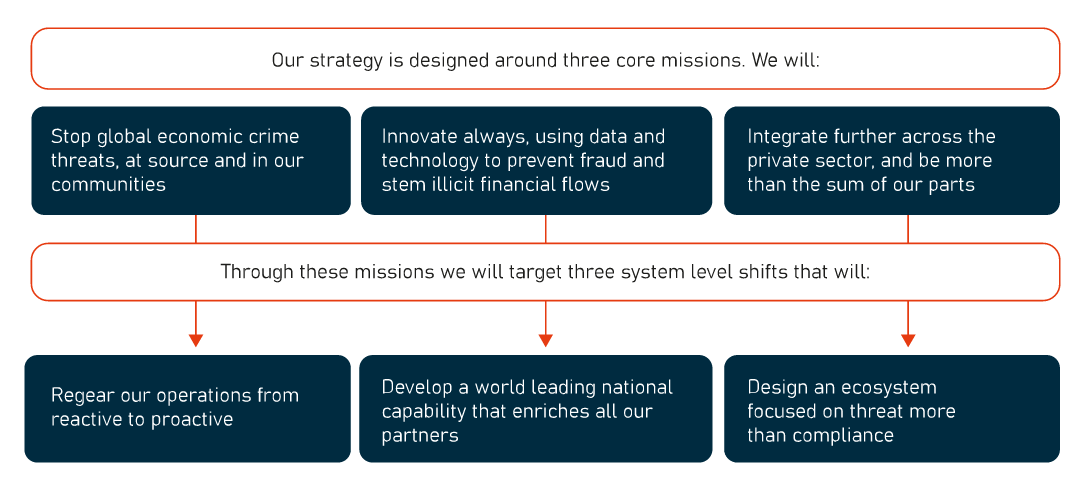
Since taking up this role, I have refreshed our strategic direction and this is reflected in our updated vision and missions. Our ambition remains for the UK to have a world-leading operational response to economic crime. We are dedicated to driving system-level shifts: from reactive to proactive, from fragmented intelligence to fusion, and from compliance-driven activity to a sharper focus on threat and harm.
The foundations we have laid this year, through initiatives such as Data Fusion, System Prioritisation and the development of the Online Crime Centre, are critical to that future vision. If we get this right, we can enable the system to move faster, act earlier and deliver greater impact for the public.
None of this would be possible without the dedication of our partners and the expertise they bring into the NECC. I take great pride in what we have achieved together this year and am confident that, with our determined team and partners, we are well placed to meet the challenges ahead.
Our Vision
To provide a world leading operational response to economic crime through:
Disrupting fraud
Delivering a coordinated and intelligence-led response through implementing key elements of the new Fraud Strategy, which includes the Online Crime Centre, and enhancing law enforcement capabilities to strengthen the response to fraud.
Disrupting illicit finance
Creating a more effective financial intelligence eco-system, taking more money out of the hands of criminals, and improving the use of Suspicious Activity Reports and Public-Private Partnerships intelligence.
Working in partnership
Strengthening Public-Private Partnerships for system impact, developing and operationalising the Online Crime Centre, driving more focused SAR reporting, alongside expansion of Data Fusion and System Prioritisation. Driving operational outcomes through facilitating national intensifications and training.
Our top line strategic direction
Executive summary
2025-2026 has been another busy and productive year for the NECC, delivering significant operational impacts and system improvements. The threat from illicit finance and fraud continues to diversify, underpinned by criminals who exploit technologies and work across borders.
The NECC’s ‘4P by default’ approach continues to disrupt and degrade these threats by bringing public and private sector partners together to achieve a range of outcomes, from arrests and prosecutions through to designing out vulnerabilities and preventing harms.
This year the NECC also set its long term strategy focussed on three systemic shifts. Collectively these shifts will create a smarter, more data-driven ecosystem that allows us to proactively target the bad actors faster and with greater precision. The NECC has worked closely with its partners in government to break ground on a suite of new national capabilities, such as the Online Crime Centre and the expansion of its Data Fusion project into a fully-fledged financial intelligence service, that will be fully operational in 2027-2028.
This report showcases highlights from the year that can be shared publicly. Looking back, it has been a year characterised by working collaboratively and focussed on innovation to not just tackle the problem at hand but also to put in place lasting solutions.
4Ps
Pursue:
we pursue offenders through prosecution and disruption
Prevent:
we prevent people from engaging in economic crime
Protect:
we protect individuals, organisations and systems
Prepare:
we prepare for when economic crime occurs and mitigate impact
How we are tackling economic crime
Disrupting crime in the community: Operations Machinize and Henhouse
Protecting victims: Operation Atlantic
Tackling fraud from overseas with international partners: Project Winterproof
Building new cross-sector capabilities: Data Fusion
Threat update and response - Fraud
Threat
Fraud is the UK’s most prevalent crime, causing significant financial losses and long lasting emotional and psychological harm, while undermining economic growth and public confidence.
Fraud accounts for approximately 45% of all estimated crime in England and Wales (Crime Survey for England and Wales), which equates to 4.15 million incidents of fraud experienced for year ending Sept 2025. The number of victims has increased significantly from the previous year, with 1 in 14 adults now estimated to have been a victim of Fraud.
For more information, the National Strategic Assessment (NSA) of Serious and Organised Crime provides the UK’s authoritative view of the illicit finance and fraud threats.
The societal shift to living more of our lives online is generating new opportunities for fraud. The online ecosystem provides ready access to products and services that allow offenders to target victims for online and offline fraudulent activity, as well as the ability to target UK victims from overseas on an industrial scale, leveraging social engineering, deepfakes, voice cloning and cryptocurrency channels to deceive victims and conceal illicit proceeds.
Our response
- Targeting the enablers of fraud and increasing our disruption efforts against sub threats such as SIM farms, malvertising and fraud enabling products.
- Leading the UK’s operational global response to scam compounds.
- Reducing the harm caused by significantly increasing our targeting of investment fraud and scaling up the prevention of high harm frauds.
- Implementing the Online Crime Centre to share cross sector data at a much greater scale and disrupt and prevent fraud at source.
Threat update and response - Illicit Finance
Threat
Most serious and organised crime (SOC) is conducted for financial gain, and the UK remains an attractive location for the laundering of proceeds of crime, generated here and further afield. Money laundering enables SOC to either cash out or reinvest profits into more crimes.
Many organised crime groups outsource the money laundering aspect of their operating model to dedicated networks that provide a service for a fee. These networks use technology and other criminal enablers (such as those working in the professional service sectors) to facilitate money laundering impacting the UK.
The money laundering methods deployed are complex and diverse. Alongside perennial methodologies, such as the criminal exploitation of cash, some represent change, or evolution.
In particular:
- We see an increasing proliferation of sophisticated money laundering networks operating across borders. These groups use a combination of novel and traditional money laundering methodologies to move value, using both the licit and illicit financial systems.
- The rapid pace of technological change presents significant opportunities for actors across the illicit financial system. This ranges from the innovative use of crypto asset products to evade detection and move illicit value at scale, to the exploitation of emerging AI tools to exploit the licit financial system through process automation and use of synthetic identities.
For more information, the National Strategic Assessment (NSA) of Serious and Organised Crime provides the UK’s authoritative view of the illicit finance and fraud threats.
Our response
- Expanding our Operation Destabilise approach to degrade and disrupt high harm money laundering networks which pose the greatest illicit finance risk to the UK.
- Using NCA and partner expertise in, for example, civil recovery, to sustain and uplift our asset denial performance and build capacity in the global response.
- Developing a more proactive and intelligence-led crypto capability to inform our response to cross-cutting priorities.
- Building a permanent capability under Operation Machinize to increase the scale of the UK response to money laundering on the UK high street.
- Designing a public private ecosystem more capable of converting bulk data into high impact intelligence and operational opportunities.
- Supporting the cross government cro effort to prepare for the Financial Action Task Force (FATF) Mutual Evaluation Report of the UK’s response to Anti Money Laundering (AML) and Counter Terrorist Financing (CTF) in 2027.
Operational highlights
Disrupting crime in the community
Machinize 2
2025/26 saw the second iteration of Operation Machinize, a national initiative targeting the criminal exploitation of high street businesses. Operation Machinize was established to target economic crime and disrupt illegal working and the grey economy.
Led by the NECC and conducted in cooperation with the National Police Chiefs’ Council (NPCC), it ran throughout October 2025 and involved every UK police force and Regional Organised Crime Unit, Home Office Immigration Enforcement, Trading Standards, HM Revenue & Customs and Companies House.
The extensive media coverage of Operation Machinize is raising awareness of the issue amongst the public, industry and government, and has led multiple partners to develop their own in-house approaches using the specialist tools at their disposal. Now on a business-as-usual footing, the NECC will continue its focus on removing the financial incentive to criminally exploit our high streets, making them safer and more prosperous places.
During the operation, the partnership delivered:
- >£10.7m - of suspected criminal proceeds seized or restrained
- 2734 - premises visited and raided
- 924 - individuals arrested
- >£2.7m - worth of illicit commodities destroyed
Henhouse 5
2025/26 saw the fifth year of Operation Henhouse, coordinated by the NECC and City of London Police. Running throughout February 2026, Operation Henhouse achieved its highest number of annual arrests and cash and assets denied.
2026 was the most successful intensification period yet, with every single UK police force and Regional Organised Crime Unit taking part in the operation. They were joined by national agencies including the Serious Fraud Office, National Crime Agency and National Trading Standards, and supported by the Financial Conduct Authority.
Operation Henhouse once again delivered outstanding results. Since its inception, it has contributed to thousands of arrests and the recovery of millions of pounds linked to fraud. The results achieved reflect the commitment of UK law enforcement and policing to tackling one of the most prolific and harmful crimes affecting people and businesses across the country.
- 557 arrests
- Seizures of cash and assets worth £18.1m
- 249 cease and desist notices
- Since the operation started five years ago, 1,904 people have been arrested and more than £67 million has been seized or disrupted.
- 172 voluntary interviews
- Account freezing orders against £9m
Protecting victims
Operation ATLANTIC
In March 2025, the NECC ran a multi-agency initiative, alongside the United States Secret Service, Canadian Law Enforcement and Regulators, Virtual Service Asset Providers aimed at identifying and contacting individuals who may have been affected by cryptoasset fraud.
The operation focused on identifying people who may have lost – or were at risk of losing – cryptoassets through a method known as “approval phishing”. This technique is frequently used in online investment fraud, where victims are manipulated into sending increasingly larger sums of money to scammers.
Law enforcement officers were joined by private sector organisations who played a critical role in tracing illicit transactions and identifying victims in real-time, meaning their money could be secured before it was moved by criminals.
Through this close partnership working across the public and private sector, 20,000 victims were identified and more than $12 million frozen in suspected criminal proceeds taken from victims in frauds.
Taking proactive action against the most serious and organised criminals
Operation Destabilise
Through Operation Destabilise, the NECC and its partners are targeting Russian-speaking illicit finance networks who launder tens of billions of dollars annually and are known to operate in at least 28 UK cities and towns.
These networks, active in the UK, purchased a bank in Kyrgyzstan to facilitate sanctions evasion and payments in support of Russian military efforts.
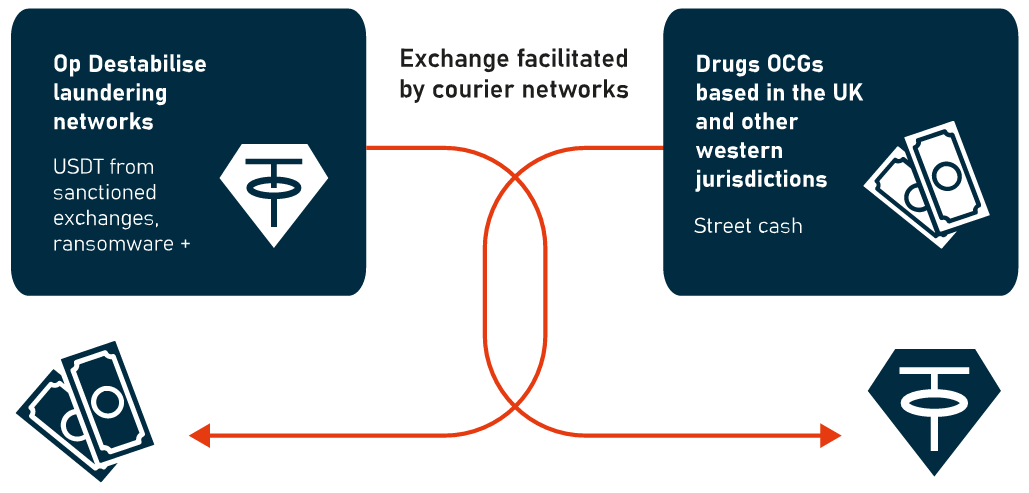
For a fee, the launderers collect ‘dirty’ cash generated from the drugs trade, firearms supply, and organised immigration crime, and convert it to ‘clean’ cryptocurrency.
These ‘cash to crypto’ swaps are an integral part of a global criminal ecosystem that spans offending in our communities, sanctions evasions and the highest levels of organised crime, including providing money laundering services to entities linked to the Russian state.
Together with our partners, the NECC is actively combatting this threat and have significantly restricted this network’s operations. In the second phase of the operation, a further 46 suspected money launderers have been arrested and over £5.1 million in cash seized in less than 12 months.
Using the intelligence gained on Operation Destabilise, the NECC has supported its international law enforcement partners in seizing $24 million and over EUR 2.6 million from the network. Since its inception, there have been a total of 129 arrests as a result of the operation, with over £25 million seized in cash and cryptocurrency in the UK alone.
Taking proactive action against the most serious and organised criminals
Expert Laundering Evidence
The NECC leads the Expert Laundering Evidence (ELE) cadre of highly skilled and experienced money laundering experts across law enforcement. These officers provide expert evidence to the courts, acting as independent and impartial witnesses to explain in simple terms their analysis of the evidence.
In 2025/26, ELE contributions supported
- 60 convictions
- 10 Director disqualifications
covering a combined total of
- £5.6 billion of laundering
- Over 300 years in sentencing
- £26 million assets denied
Tackling the abuse of SIM cards
Over 2025/26, the NECC has taken a multi-pronged approach to disrupt and prevent SIM abuse for the purposes of committing fraud.
SIM cards are used by fraudsters to send scam text messages at scale to victims (SMS phishing – or smishing). In addition, SIM cards are being diverted in bulk from UK retail distribution to facilitate large scale fraud, whereby SIM cards are not used for legitimate calls, but instead are used to receive one time passwords to set up social media or messaging accounts that appear to be UK based, and which can then be used to commit fraud. Multiple SIM cards are often loaded into SIM boxes/farms to allow automation of this at scale.
Building the partnership between law enforcement and the telecommunications sector has been key to our approach to tackle this threat. Two examples of how this partnership has achieved results are as follows.
Case study - tackling smishing in the UK
The Fraud Targeting Cell (FTC) is a joint collaboration between the National Crime Agency and City of London Police developing proactive intelligence to tackle fraud.
In 2025/26, the FTC worked with Mobile Network Operators (MNOs) to trial an innovative approach to identify subjects orchestrating nationwide smishing campaigns. This included using industry held data, such as 7726 fraud reporting and location information, combined with law enforcement intelligence to identify and prioritise the most significant subjects involved in running UK-based smishing farms.
FTC developed intelligence packages for operational partners, which resulted in:
- 4 arrests
- 1 cease and desist
- 1 SIM farm disrupted
- Thousands of pounds cash seized
- High value watches seized
- 1m+ compromised card details shared with banking sector for safeguarding
Case study - disrupting overseas scam compounds
A box of UK SIM cards were seized on the Thai border, diverted from their legitimate distribution channels and clearly headed for South East Asian scam compounds. With assistance from the Royal Thai Police and the NECC’s Ofcom embed, the NECC cross-referenced serial numbers with UK suppliers. This enabled telecoms operators to share the identified SIM numbers into Stop Scams UK (SSUK), a membership programme of telecom, financial and tech platforms, to stop the risk of sim diversion and stop fraud at source.
While telecommunications providers can identify and disconnect these numbers for breaching terms and conditions, the accounts previously authenticated through them often remain active and available to use for malicious purposes. SSUK’s tri-sector model has provided a platform for industries impacted by this activity to collaborate. By sharing blocked SIM data via SSUK, participating members can now identify and disrupt fraudulent accounts, as the initial breach of terms indicates a high risk of fraud. This data sharing allows for an ecosystem-wide approach to ‘burning down’ the fraud route.
Partnership highlights
Joint Money Laundering Intelligence Taskforce (JMLIT)
The JMLIT has more than 200 members across the public and private sectors. It supports investigations with private sector information and develops knowledge of typologies to tackle high end money laundering and serious financial crimes. In 2025/26, the JMLIT has directly or indirectly generated the following outcomes:
- 1638 New accounts identified associated with criminality
- £47,201,528 identified, restrained, seized, filed for civil recovery
- 326 New suspects identified
- 105 Arrests
Alerts
Through its Public Private Partnership network, the NECC issues Alerts to industry to promote awareness of specific threats and bring about preventative action. In 2025/26, the NECC issued 13 Alerts, including 3 Red Alerts:
- Shadow Fleet Sanctions Evasion and Avoidance Network
- Operation DESTABILISE
- Russian Trade Sanctions Circumvention
Case study - Digital Wallets Alert
Digital wallet fraud is a rapidly growing financial crime where criminals add stolen bank card details to mobile wallet apps without the cardholder’s knowledge. Criminals then exploit elements of the verification process linking a card to a digital wallet. Once the stolen card details have been added, the wallets can be used to bypass standard banking fraud controls to enable fraudulent purchases or further re-sale by the fraudsters
Following engagement and knowledge sharing with private sector partners through the new Online Crime Centre, a NECC Amber Alert on Digital Wallet Abuse was commissioned to warn of the increasing threat.
Led by an Ofcom secondeee in the NECC with the relevant technical expertise, this work also had input from trade associations and regulators to ensure a cross-sector perspective.
The final Alert detailed methodologies used by criminals to abuse digital wallets, aiming to assist financial institutions in detecting and preventing this fraud.
JMLIT 10 Year Anniversary
2025/26 marks 10 years since the launch of the JMLIT, which has evolved and expanded exponentially into a mature and multifaceted Public Private Partnership model. An event to mark the occasion in July 2025 was attended by over 200 key industry partners, who reflected on the progress made and looked ahead to future challenges and ambitions.
Maturing and expanding our private sector partnerships
System prioritisation
The UK’s response to economic crime is a collaborative effort. Partnership with the private sector is essential to prevent, identify and disrupt the financing of organised crime. To support public private collaboration, the NECC has secured agreement with the FCA, Home Office and Treasury on nine Economic Crime System Priorities to support decision making in the regulated sector. This work has been conducted with the close support of representatives of the financial sector through UK Finance. The priorities, delivered as part of the Economic Crime Plan 2, were published in July 2025.
These priorities are aligned to both the National Risk Assessment (NRA) of Money Laundering and Terrorist Financing, and the National Strategic Assessment (NSA) of Serious and Organised Crime. They are intended, with the full endorsement of the FCA, to support the relevant regulated sector in allocating resources to where they can have the most impact on the threat, on a cost-neutral basis while maintaining their regulatory responsibilities.
These nine priorities are focussed on:
- Professional Enablers
- Politically Exposed Persons
- Cryptoassets
- Criminal cash
- Money laundering linked to priority jurisdictions
- Fraud perpetrated by international offenders in priority jurisdictions
- Money mules
- Fraud originating from telecommunications services or online platforms
- Terrorist financing
To read the priorities in full, visit the NCA website. Home.
Academic engagement
Following the first NECC and Home Office conference with academia last year, 2025/26 saw the publication of an associated RUSI report, highlighting some of the gaps and challenges in research and academic engagement with government and law enforcement.
This report formed the basis of the NECC plan to overcome these obstacles. As well as securing funding for research through the ARIS, the NECC, alongside the Home Office, published joint Areas of Research Interest, based on economic crime, outlining research questions for academics and researchers.
The first research project proposal to be funded through this has been agreed by the NECC and Home Office. The University of the West of England is leading the research over the next 15 months, aiming to build a better understanding of the impact of asset recovery on criminals and their behaviour. The findings will enable us to develop and use the most targeted and effective interventions.
Tackling fraud from overseas with international partners
Project Winterproof
Through Project WINTERPROOF, the NECC has led the response to tackling fraud with an overseas nexus in 2025/26. The NECC has worked with partners across the globe and taken a range of actions to tackle the threat from different angles.
Ghana
A highly successful communications campaign, supported by a hotline for reporting fraud - Report Sakawa.
This campaign:
- Increased awareness of Romance Fraud in Ghana;
- Served as an important prevention strategy;
- Resulted in over 6,000 calls to the hotline.

South East Asia
Working with global public and private sector partners to tackle the proliferation of scam centres in the region and safeguard trafficked and exploited individuals; as well as build capability in the region.
In two cases last year, the NECC worked with Meta and international law enforcement partners to develop and share intelligence on scam compounds and take operational action. This resulted in:
- 60 individuals safeguarded
- 21 arrests
- 150,000 accounts associated with scam centres closed
Nigeria
The signing of the UK/Nigeria Fraud MoU in April 2025 was the launch pad for significant capacity and capability support to Nigerian partners operating in the fraud space.
Building capability: with City of London Police, we have delivered training to enhance our partners’ ability to effectively tackle the threat of fraud in Nigeria and the UK. As fraudsters pivot to different platforms to try and evade law enforcement attention, Nigeria has been given the training and tools to effectively combat this.
Disrupting criminals: Collaboration with Meta and the Nigeria Police Force – National Cyber Crime Centre resulted in the successful take down of a scam centre, the arrest of 7 fraudsters and the reduction in harm to UK victims. This was the first UK/Nigeria/Meta collaboration and has paved the way for more activity.
Preventing fraud: The NECC worked with the NCA, Nigeria Police Force – National Cyber Crime Centre to develop and launch the ‘Real Odogwu’ fraud-focused communications campaign to dissuade people from engaging in fraud and inform young people of the risks of becoming perpetrators of fraud.
India
Following an 18 month collaborative investigation involving the Indian Central Bureau of Investigation (CBI), the NECC, NCA, FBI and Microsoft Digital Crimes Unit, enforcement action was undertaken against a fraud call centre, resulting in the arrest of two key individuals and the seizure of a large amount of digital devices.
The operation targeted a sophisticated Organised Crime Group (OCG) that fraudulently solicited payments from victims by posing as Microsoft employees. The investigation was initiated after the NCA received intelligence from Microsoft, which was then cross-referenced with more than 100 Action Fraud reports from UK victims, as well as with the FBI.
The combined effort of the NECC, FBI and Microsoft successfully identified key suspects in India and compiled a robust file of evidence, which included victim testimonies supported by the City of London Police. This resulted in executive action and an on-going investigation by the CBI.
Innovation highlights
Building new cross sector capabilities
Data Fusion
One of the cornerstones of our Public-Private Partnership model is its ability to respond to a changing landscape, looking at new ways to approach data sharing with partners to address new emerging and challenging threats. Data Fusion, led by the NECC, is a prime example of this. Working jointly with law enforcement and eight major UK banks to combine data, specialised personnel and analytical expertise from across both sectors.
Building on the success of Data Fusion, the NECC is now working with public and private sector partners to create a more effective financial intelligence ecosystem, using data, technology and partnerships.
This will:
- Expand our Fusion secondees to include representatives from across the ROCU network and to improve the cascade of intelligence into regional and local level partners.
- Build the partnership between the NECC and the banking sector and replicate it with other sectors responsible for the movement and storage of value.
- Enhance and increase the volume of data underpinning the capability and utilise Large Language Models and Machine Learning to improve prevention, targeted disruption and asset recovery.
- Work across borders by establishing a global public-private network to target upstream threats harming our collective interests.
Ultimately, with the objective of re-gearing the response by reducing the volume of lower utility compliance activity and increasing our proactive effort to achieve high impact disruptions.
Since July 2025, Data Fusion has:
- Established the Joint Analytical Team as a core component of UK economic crime architecture
- Delivered 100+ disseminations of financial intelligence to NCA and law enforcement partners for action
- Led to the opening of 50+ pieces of intelligence activity in the NCA
- Delivered 50+ disseminations to banks, allowing banks to review, adjust and implement risk mitigation measures
- Improved the collective understanding of the illicit finance threat Online Crime Centre
Online Crime Centre
The Online Crime Centre was announced in the UK Fraud Strategy in March 2026. During 2025/26, the NECC, as part of the NCA, has worked collaboratively with the Home Office and City of London Police to test concepts and build the new centre. This includes delivering pilot activities to prove key concepts, such as data sharing and design out initiatives, and undertaking constant stakeholder engagement with key industry partners.
The Online Crime Centre brings together UK policing, the intelligence community, and key private sector partners across finance, telecoms, technology, cyber security and academia. For the first time, this collaboration will unite data, expertise and operational capability in one hub to strengthen the UK’s response to online crime, with an initial focus on fraud and high volume cyber offences. It provides the technology and governance required to share data securely, at scale and at speed, delivering a fuller national picture of online crime.
The Online Crime Centre will:
- Deliver collaborative design-out campaigns
- Enable high volume data sharing between sectors
- Provide a national centre of expertise
- Co-develop innovative interventions with industry and academia
- Build, test and evaluate new technologies and solutions
- Maximise impact at scale
Performance
Disruptions
All disruptions
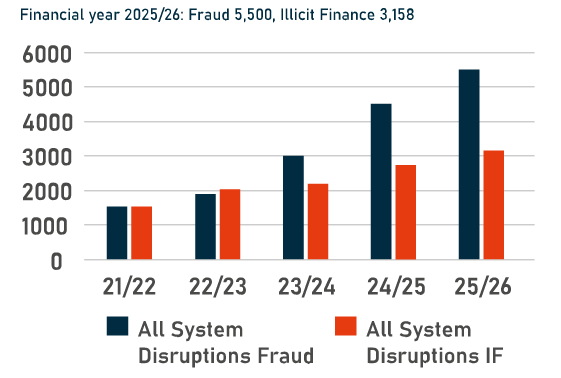
As the pages of this report have shown, the NECC continues to deliver wide ranging impact across economic crime threats, driving activity across the system, including UK police forces and other law enforcement agencies.
The impact of NECC – and wider law enforcement – activity against SOC is measured through ‘disruptions’. A disruption is any activity that results in evidenced impact against a SOC threat e.g. an arrest, improved resilience following an education campaign, a denial of illicit assets or the takedown of a website.
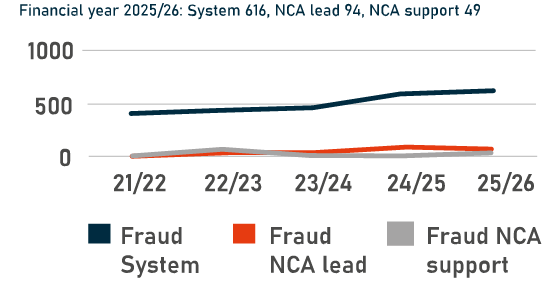
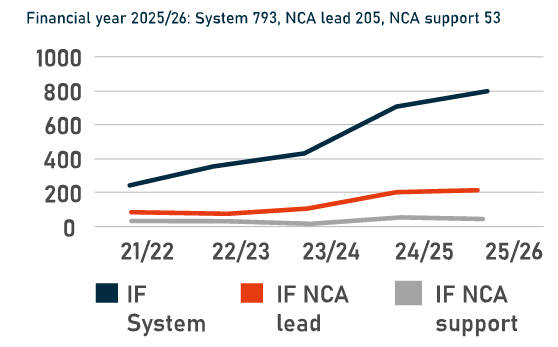
The work undertaken by the NECC this year, to drive an increased, proactive focus on money laundering and fraud, has supported improved performance across the NCA and wider system. The graphs here show system performance - that is activity and impact delivered by all law enforcement partners collectively. It is included here to reflect the NECC’s system leadership role and should not all be attributed to the NECC. Many other factors will also have contributed to this improved performance, including continued investment and national strategies.
Major/moderate impact disruptions
In order to assess the level of impact achieved, the NECC specifically focusses on a subset of the above disruptions – those that have had a major or moderate impact on the threat or an organised crime group.
The charts below show the major and moderate disruptions across the whole system and then the NCA part of that as a subset of the whole. This includes where the NCA was the lead agency, as well as ‘NCA support’, where NCA activity provided an invaluable contribution to enable a partner to achieve the disruption. This additional level of detail is included here to demonstrate the important role the NECC plays in supporting our partners to deliver and enabling the system to operate more effectively.
These charts show a continued upward trend in disruptions against the most harmful fraud and money laundering threats. Whilst ‘NCA lead’ fraud disruptions have fallen slightly in 2025/26, this is due to the NECC’s increasing focus on collaboration and delivering disruptive and preventative activity through partners – with overall disruptions continuing to rise.
*This data is correct at the time of reporting and is subject to change.
All system disruptions
Fraud major/moderate disruptions
Illicit Finance major/moderate disruptions
Asset Denial
Asset Denial aims to substantially reduce the level of serious and organised crime affecting the UK by denying criminals access to their illicit assets, recovering the proceeds of crime, and deterring and disrupting further criminality. In 2025/26:
- NCA denied significantly more assets to criminals compared to the previous three year average, with a 198% increase in the value of assets denied and a 76% increase in the value of assets recovered.
- Whilst the value of NCA orders obtained decreased slightly, the volume of orders increased. This change is due to a small number of unusually high value orders in the previous three years.
- Across the system, values of assets denied, orders obtained and assets recovered also all increased, demonstrating a strong year of denying assets to criminals.
Resources
The NECC is a multi-agency centre. Funding and secondees from partners are critical to its success. In 2025/26, the NECC benefitted from support from a variety of public and private sector organisations.
At the end of the 2025/26 financial year, the NECC had 129 full time equivalent (FTE) in post.
Over the course of 2025/26, the NECC had a total of 16 secondees from 10 different partner agencies: City of London Police, Companies House, Financial Conduct Authority, Greater Manchester Police, HM Revenue and Customs, Home Office, Ofcom, The Pensions Regulator, Serious Fraud Office, Standard Chartered.
Five banks provided staff into the Joint Analytical Team established as part of Data Fusion: Barclays, Lloyds Banking Group, Natwest Group, Nationwide and Santander UK.
For more information, please visit:
- National Economic Crime Centre
- Follow us on LinkedIn: @National Economic Crime Centre (NECC)


