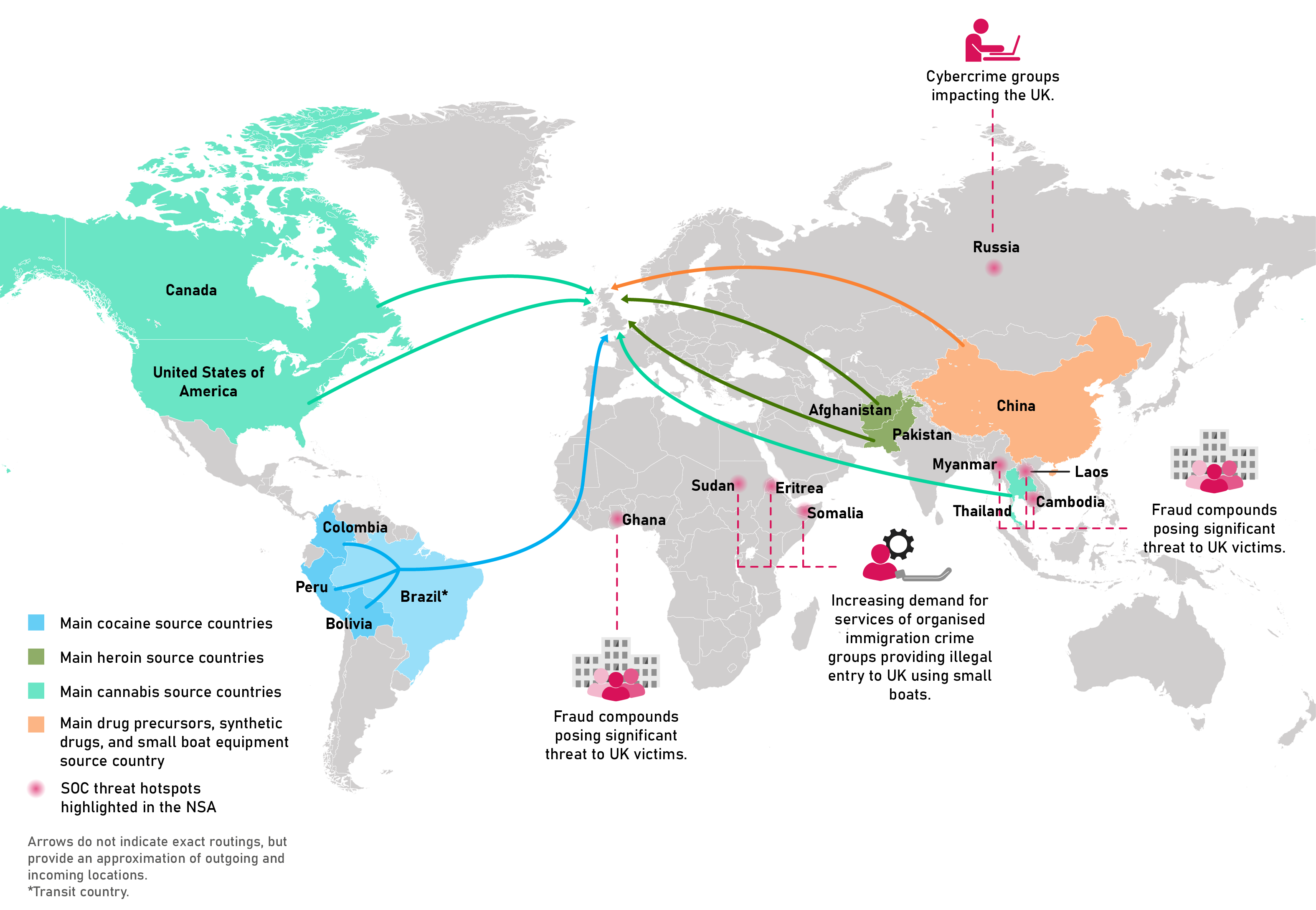
Globally, the threat from transnational SOC continues to grow, posing a significant threat to local communities and nation states. The majority of SOC impacting on the UK likely has some direct or indirect overseas links; for example, most illicit drugs sold in the UK are imported from abroad. Trends and emerging threats which first appear overseas can often become evident in the UK as the highly interconnected nature of global SOC sees criminal methodologies and illicit commodities spread quickly throughout the world.
The globalised and interconnected nature of SOC means any changes to national policies and legislation made in one jurisdiction will have a rapid impact in other countries as transnational organised crime groups adapt and exploit new opportunities. Examples include organised crime groups responding at speed to the decriminalisation of cannabis in Thailand, and elsewhere, in order to supply the UK; the growth of opium cultivation in Pakistan following the Taliban’s ban on narcotics production in Afghanistan; and the tightening of asylum policies and legislation in mainland Europe pushing larger numbers of people to attempt irregular entry to other countries including the UK.
Adaptability of Commodity Flows | Cocaine Routes
In 2025, the clearest shift in global supply chains is evidenced in changes in the cocaine supply chain as organised crime groups utilise new routes and methods (such as the use of semi-submersible submarines and chemical concealment of cocaine) and exploit new opportunities presented by organised crime group collaboration and technology. Production and consumption of cocaine have never been higher, and pricing has never been lower. Cocaine trafficking drives violence, corruption, and instability along the supply routes. The number of drug-related deaths in the UK linked to cocaine use has increased for the 12th consecutive year.
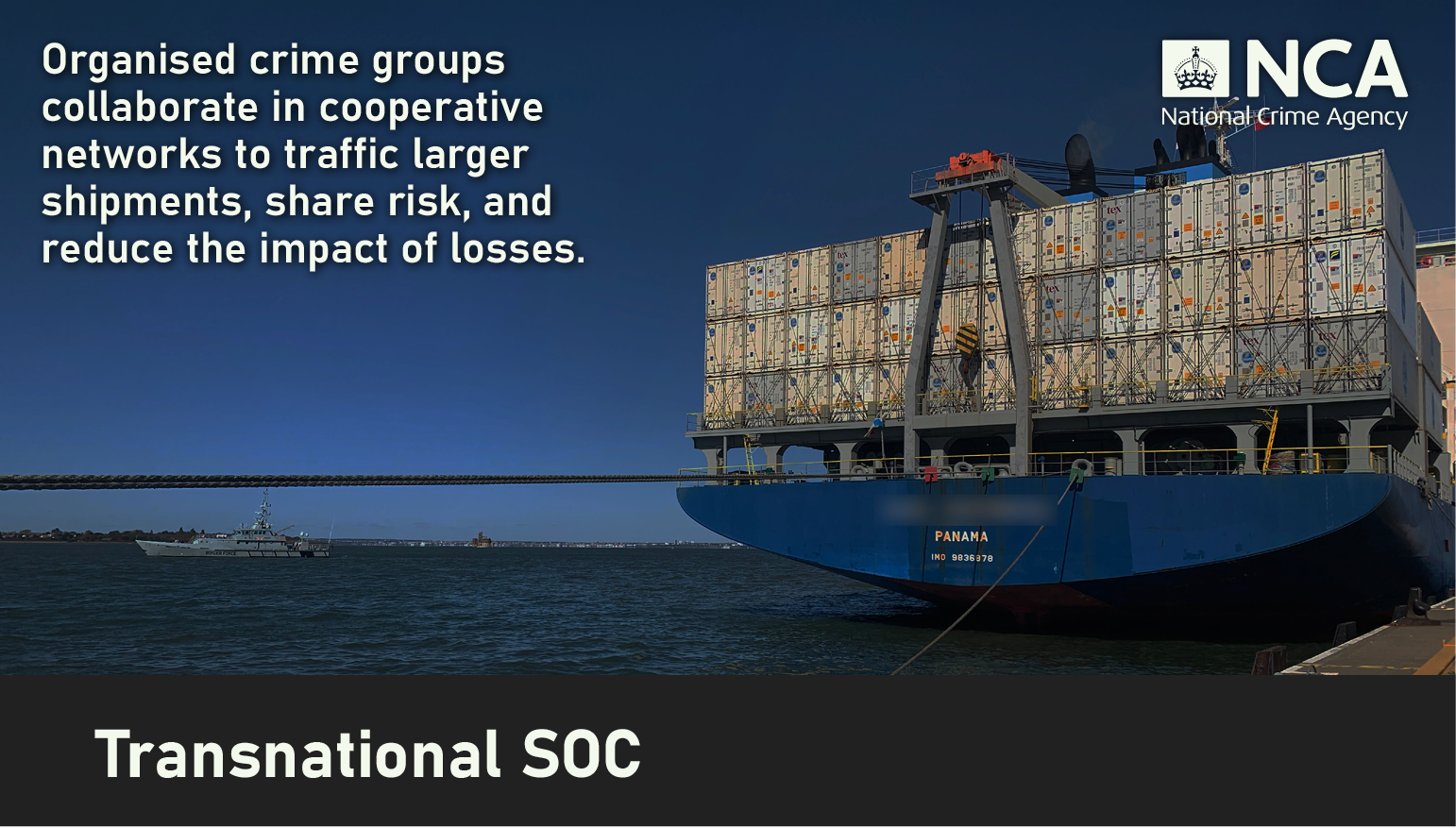
It is highly likely organised crime groups importing cocaine are increasingly collaborating globally as a large cooperative network to traffic larger shipments of cocaine into Europe and the UK, share transportation networks and risk, and minimise the impact of losses. Multi-tonne shipments and groupage loads are increasingly common.
It is highly likely Western Balkan organised crime groups retain the highest level of control over the end-to-end supply of cocaine (importations and wholesale distribution) from source countries to the UK’s streets. Their development of direct relationships with South American cartels enables them to buy cocaine at wholesale prices then resell in Europe and the UK at high profit margins.
Growing legitimate trade links between Brazil and West Africa have provided organised crime groups with greater opportunities to use commercial and container shipping modes to smuggle cocaine across the Atlantic and on to Europe and the UK. Sustained investment in maritime infrastructure in West Africa has boosted connectivity.
Western Balkan organised crime groups operate throughout West Africa, collaborating with Brazilian organised crime groups to facilitate multi-tonne cocaine shipments. They have embedded brokers in West African countries who organise logistics, establish infrastructure and liaise with local actors including corrupt law enforcement and port operators.
Exploitation of Conflict, Instability, and Weak Governance
Conflicts in the Middle East, Myanmar, Sudan, and Ukraine, as well as post-conflict transitions in countries such as Afghanistan and Syria, terrorist insurgencies across Africa, and high levels of SOC-related violence in Latin America are all contributing towards geopolitical vulnerabilities which offer new criminal opportunities to organised crime groups.
It is highly likely that opportunities for organised crime groups to innovate, network, and capitalise on global vulnerabilities are increasing. Areas of instability, weak governance, or conflict provide fertile ground for exploitation by SOC offenders. Such areas commonly lack fully functioning law enforcement to combat SOC and are instead characterised by state dysfunction, partnerships between conflict actors and criminals, high levels of corruption, and dependence on grey or illicit economies in which SOC thrives.
The spread of fraud compounds in areas of South East Asia is a recent example of how organised crime groups exploit areas affected by conflict and subsequent weak governance. Once the template is established, it can be replicated elsewhere and grow into a significant global threat largely unhindered by law enforcement. The civil war in Myanmar in particular was exploited by organised crime groups taking advantage of the corruption and lawlessness found in areas of conflict, targeting locations which are geographically remote and less likely to draw political or law enforcement attention. The phenomenon has now spread far beyond the region.
Global instability as a result of conflict, economic disparity, or natural disasters is a primary driver of transnational organised immigration crime. The resulting irregular migration drives demand for the services of organised crime groups who profit from smuggling vulnerable people across national borders. Data relating to the nationalities of irregular migrants most commonly entering the UK confirms the link between instability and organised immigration crime.
The Threat from State Actors Harnessing SOC Threats
It is highly likely that some foreign states, including Iran and Russia, have sought the assistance of criminals or organised criminals to pursue their state strategic objectives. These states also continue to be permissive of SOC activity which supports their objectives and is conducted from within their jurisdictions. For example, ransomware-enabling services operate from countries such as Iran and Russia, which are uncooperative to Western law enforcement, and this makes disruption more problematic.
It is highly likely that plausible deniability is the principal rationale for these states harnessing SOC to pursue their strategic objectives. The intent behind this activity varies, including using crime to support state finances, evade sanctions, intimidate dissidents, and subvert government authority domestically through hybrid threat vectors such as irregular migration and sabotage.
Case Study | Romance Fraud in West Africa
In 2025, a Nigerian fraud organised crime group was identified basing their criminal activities in Ghana using forced labour. One operation discovered a huge modern slavery and human trafficking ring in which over 200 people had been trafficked into a compound where they were forced to carry out romance fraud against victims worldwide.
Victims were forced to work in appalling conditions on only one meal per day. The trafficked individuals were mostly young Nigerian males who had been recruited in Nigeria with the promise of lucrative work.
The leaders of the organised crime group were based in Nigeria, and money was transferred to, and laundered by, individuals in Nigeria. Whilst the use of forced or coerced labour to commit fraud has been seen sporadically, its use on this scale is more commonly linked with South East Asian or Chinese organised crime groups.
This operation was initiated in response to a referral into the ‘Report Sakawa’ line – an NCA fraud media campaign launched in collaboration with Ghana's Economic Organised Crime Office and the British High Commission in Accra, encouraging members of the public in Ghana to anonymously report suspicious activity. Online fraud centres using human trafficking victims are a growing trend, causing harm to victims across the world and the NCA is committed to tackling the organised crime groups responsible.
Transnational SOC Threats to the UK