A wide range of SOC threats cause harm to individuals in our communities including the supply of illicit drugs, use of weapons including guns and knives, and serious violence and coercion. SOC threats involving the use of abuse and exploitation, such as child sexual abuse and modern slavery and human trafficking, often harm some of the most vulnerable individuals in our societies.
Drugs
The overall threat to the UK from illicit drugs is likely to have increased in 2025. Several trends indicate an increase in the threat: a wider variety of substances, lower wholesale prices than in 2024, significant increases in volumes of ketamine and cannabis seized at the UK border, an increase in consumption of a range of substances, and an increase in drug-related deaths.
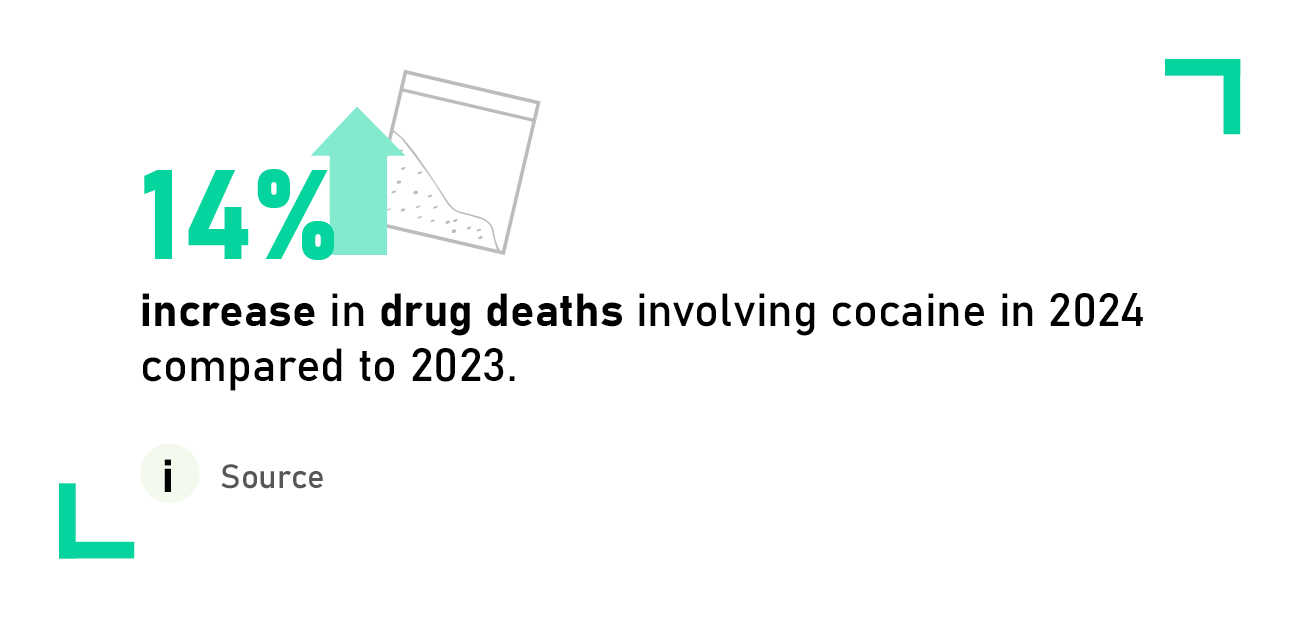 The threat from cocaine remains high, with seizures in the UK having increased by more than 440% in the last 10 years, from 3.4 tonnes in 2015 to 18.5 tonnes in 2025. Cocaine prices were lower in 2025 than in 2024, while wholesale purity levels remained consistent, likely reflecting robust and adaptable supply chains and high levels of production in source countries. The increase in availability is a likely cause of lower prices, with competition for market share amongst criminals also likely contributing. Deaths where cocaine use was a contributory factor increased significantly in England and Wales in 2024, rising by 14% to 1,279 deaths, 11 times higher than in 2011 (112). It is highly likely that poly-drug use contributed to the registered cocaine-related deaths, although it has not been possible to determine all contributing factors.
Overall drug-misuse deaths in England and Wales have continued to increase with a 3% rise from 3,618 deaths in 2023 to 3,736 deaths in 2024, according to the Office for National Statistics. However, there has been a mixed picture across the UK, with an overall decrease in drug-related deaths in Scotland and Northern Ireland. Scotland continues to have much higher drug-related deaths per capita than all other UK regions. Overall, drug misuse deaths in Scotland decreased by 13% from 1,172 in 2023 to 1,017 in 2024. Deaths due to drug-related causes in Northern Ireland decreased by 22.5% from 218 deaths in 2020 to 169 in 2023.
The heroin market in the UK was stable in 2025, despite ongoing market uncertainty related to the Taliban’s narcotics ban in Afghanistan since 2022. Although heroin supply into the UK has remained steady overall, in terms of seizures and purity levels, it is highly likely that UK-based drug suppliers will continue to fortify heroin, and illicit pharmaceutical drugs, with more harmful substances, including synthetic opioids. This significantly increases the risk of harm with many users unaware if heroin or illicit tablets have been fortified. In addition, the practice of poly-drug use, where users consume additional drugs or alcohol, will almost certainly increase the risk of overdose.
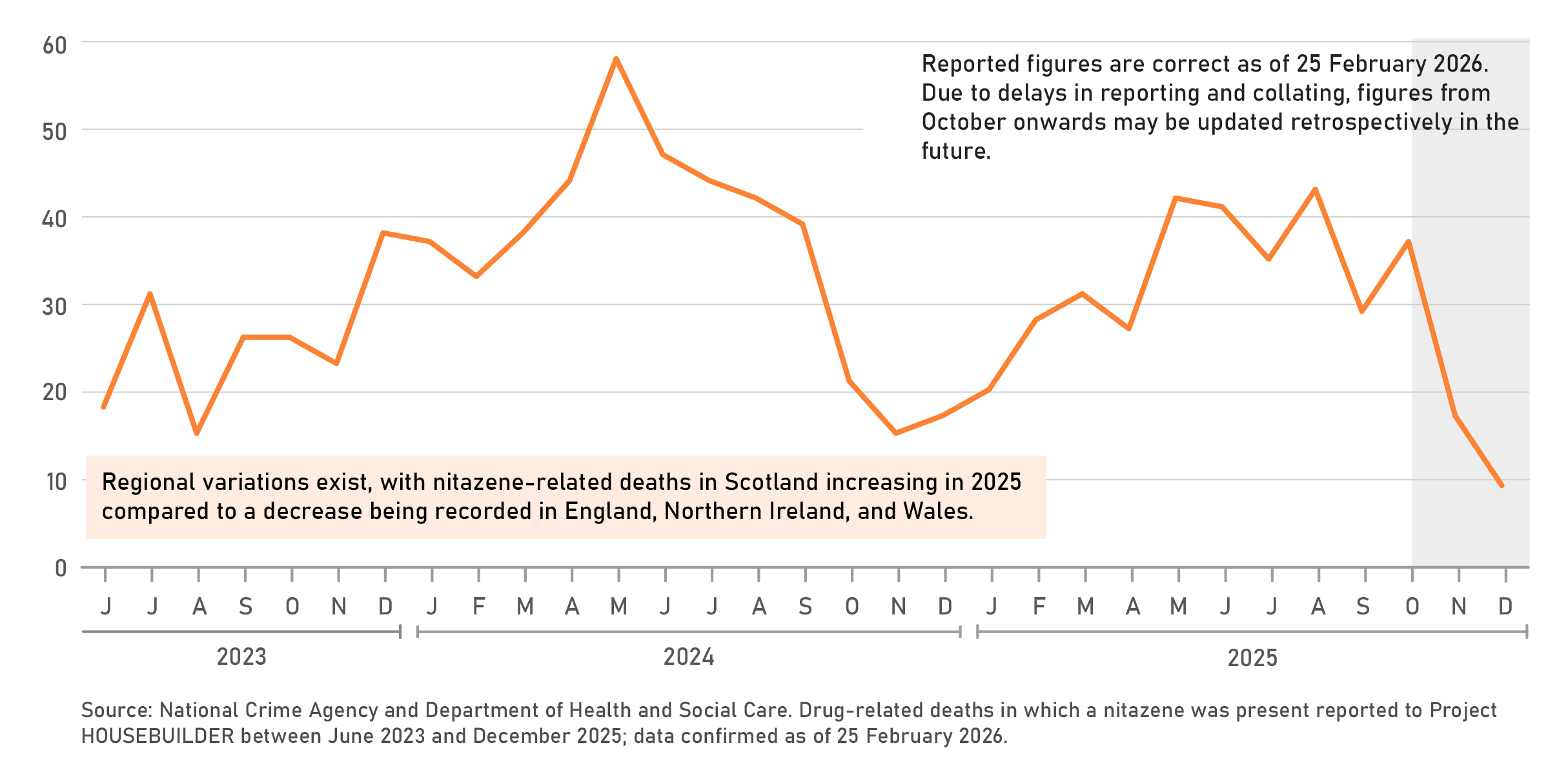
Although the synthetic opioid market continues to evolve, there was a decrease in the number of recorded nitazene-related deaths in the UK in 2025 to 359 deaths, a reduction from 435 in 2024. However, the figure for 2025 is expected to increase as additional test results are finalised. There were some regional variations in 2025 with nitazene-related deaths increasing in Scotland compared with England, Wales, and Northern Ireland where they decreased.
Naloxone is used widely by first responders and hospitals to reverse opioid overdoses. Take-home naloxone kits are also distributed to people who use opioids, and others who may witness overdoses, by a range of services. However, it is not currently possible to assess the overall impact on drug-related deaths and non-fatal overdoses due to data gaps.
It is almost certain that organised crime groups have been adapting their business models to meet persistent demand for a range of substances associated with the night-time economy and general recreational drug use. This includes drugs such as cannabis, cocaine, and ketamine.
It is likely that the threat from ketamine continued to increase in 2025. The number of ketamine users starting drug treatment in 2024 to 2025 (5,365) in England is now over 12 times higher than it was in 2014 to 2015, when the number was 426. There has been a rise in the number of children aged 17 or under entering drug treatment and reporting a problem with ketamine use, from 512 in 2021 to 2022, to 1,465 in 2024 to 2025. Long-term abuse of ketamine can commonly lead to uropathy, often culminating in the need to surgically remove the bladder. Ketamine-induced uropathy has been increasing in the UK, particularly in the younger population, with some urology departments responding by setting up specialist clinics.
It is likely that the volume of ketamine entering the UK is increasing to meet higher demand. In the year ending March 2025, there was a 34% increase in the total quantity of ketamine seized by Border Force compared with the previous year, from 769kg to 1,029kg.
It is likely that drug organised crime groups are increasing their use of sophisticated chemical techniques to conceal or produce drugs. The operation of illicit laboratories poses an inherent risk to the public, both from exposure to harmful substances, the potential for explosions, and the harm caused to the environment by waste products.
Drug distribution models continue to adapt to market changes. It is likely that the number of county lines was broadly stable between 2024 and 2025, with a shift towards a more localised model of drug distribution and a significant rise in social media lines.
Violence, Weapons, and Coercion
It is highly likely the threat from SOC-related violence in the UK remains broadly stable but there is a mixed picture across regions. Imitation weapons, cross-commodity criminality, and organised crime group tensions continue to generate harm to UK communities through intimidation and violence. Drug supply continues to be a significant driver of SOC-related violence, including use of firearms. These dynamics are likely to sustain public perception of an increasing threat despite a relatively stable number of incidents.
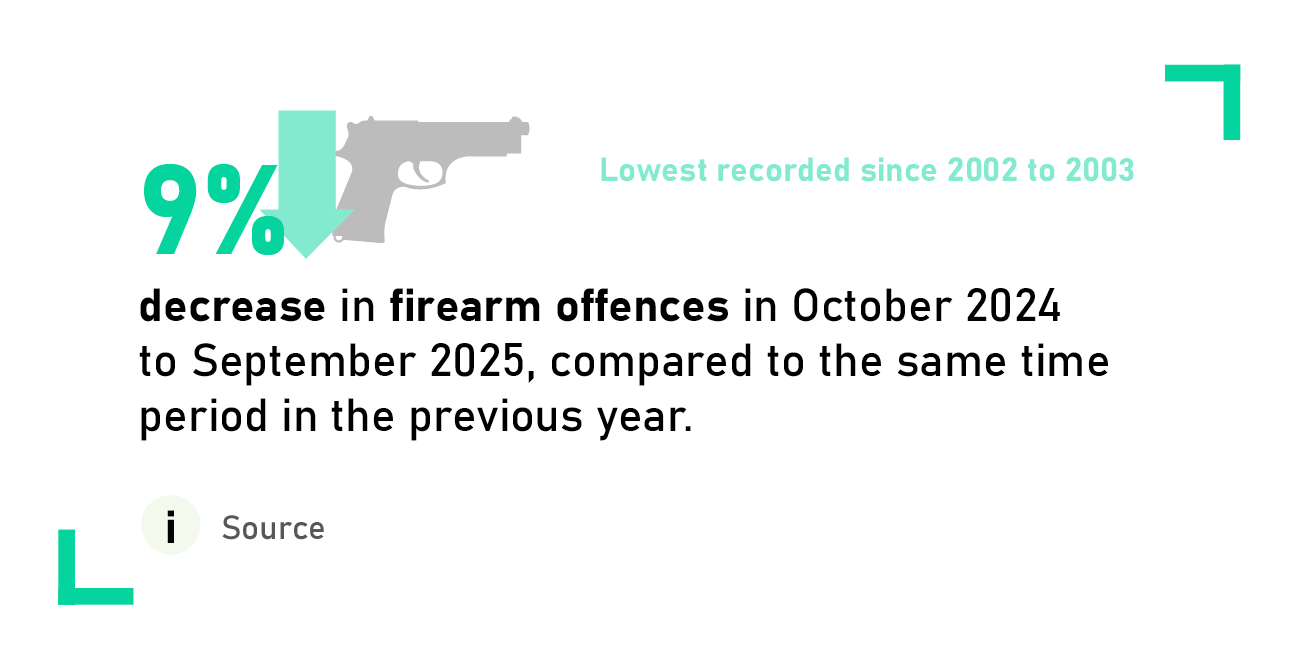 Firearm use in the UK remains low with offences decreasing by 9% (from 5,356 to 4,851 offences) in England and Wales in the year ending September 2025, according to the Office for National Statistics. This was the lowest level of offences since current police recording practices began in the year ending March 2003. There were 36 homicide offences involving a firearm in England and Wales in the year ending March 2025; this was slightly higher than the ten-year average of 31 but within the expected range. Indirect threats (for example, verbal threats where no firearm is seen, or threats made on social media) are now more common than threat incidents where an actual firearm is involved or seen.
Although criminal capability to source and use firearms is unlikely to have changed significantly, it is highly likely the use of counterfeit firearms is increasing. It is likely the number of injuries and fatalities will increase as counterfeit firearms are of better quality, and can use more powerful ammunition, than the converted top-venting blank-firers most prevalent in criminality in 2023 to 2024. Less availability of convertible blank-firers in Europe is likely causing criminals to seek alternative firearms, such as counterfeit firearms.
Trends observed in some parts of northern Europe in 2025 have seen organised crime groups increasingly outsource serious violence, including firearms offences, to third parties, often children. The UK has not seen UK-based criminals use children and individuals outside their core networks to carry out violence-as-a-service in the same volume, with only a small number of cases.
Knives continue to be used significantly more in serious violence than firearms due to their availability. Within a SOC context, criminals using only knives are likely to be lower-tier criminals involved in urban street gangs or county lines activity, typically motivated by physical protection, self-advancement, and promotion of gang identity.
It is likely that the threat from knife crime reduced overall in 2025, in part due to targeted policing efforts. Office for National Statistics figures indicate a 9% decrease (from 55,149 to 50,430 offences) in knife-enabled crime to the year ending September 2025. There was also a 10% decrease in knife-enabled robbery in force areas targeted by the UK Government’s taskforce between the year ending June 2024 and the year ending August 2025.
SOC‑related vendetta kidnaps continue to be used by criminals involved in a range of SOC including county lines, drug supply, money laundering, modern slavery and human trafficking, and organised immigration crime. Although the number of kidnaps reported to the NCA was stable in 2025, the number of incidents has steadily increased since 2018.
Most incidents of violence against women and girls do not relate to SOC. However, the attitudes and behaviours that underpin violence against women and girls can act as a driver of SOC offending, both in highly gendered forms of offending such as child sexual abuse, modern slavery and human trafficking, and organised prostitution, and in forms of offending in which women and girls are actively recruited into criminality, such as in urban street gangs involved in drug supply.
Abuse and Exploitation
SOC-related abuse and exploitation continue to harm some of the most vulnerable individuals in our communities, including children. Organised crime groups continue to exploit young people as couriers and facilitators across multiple threat areas including drug supply and fraud. Recruitment of money mules remains a persistent money laundering method with under-18s and students specifically targeted.
The scale of child sexual abuse and exploitation continues to maintain high levels, with the volume of child sexual abuse offences reported to Police in England and Wales remaining broadly consistent in 2025 (122,768, 6% more than in 2024). Children are increasingly being exploited to produce more indecent and depraved imagery, and offenders’ sophistication online is increasing their capability to target and harm children. The complexity and severity of the threat continues to grow, with the levels of physical and psychological harm to victims resulting from all child sexual abuse and exploitation offending remaining high into 2026.
Offenders continue to identify and target vulnerable individuals both offline, such as in contact group-based child sexual abuse and exploitation, and through the exploitation of online environments, through the indiscriminate targeting of multiple victims.
Contact child sexual abuse and exploitation offences recorded by police in England and Wales remain consistently high: in 2024 accounting for 65% of all child sexual abuse and exploitation crimes, and more likely to involve a known perpetrator (87%) than non-contact offending. Where a relationship was recorded, a quarter of abuse occurred in the familial environment, with parents the most common perpetrators in familial contact child sexual abuse and exploitation offending, followed by siblings. However, all child sexual abuse and exploitation offending remains under-reported, which continues to impact wider understanding of the threat.
It is likely that the threat from group-based contact offending has remained stable between 2023 and 2025. Within contact child sexual abuse and exploitation, group-based offending accounted for 5.6% of all offences in 2024, according to the Hydrant Programme. The complexity of group-based offending is likely a factor in the low volume of reporting to police.
The Hydrant Programme classify group-based child sexual abuse and exploitation into seven categories: Child-on-child (24%), Child Sexual Exploitation (17%), Familial (32%), Institutional (9%), Ritualistic, as well as Other (11%) and Unknown (6%). The most notable change was a 6% increase in crimes categorised as ‘Familial’, rising from 26% in 2023 to 32% in 2024. Offence types committed remained consistent, with rape remaining the highest recorded offence, followed by sexual assault.
Case Study | First Cocaine Extraction Laboratory Discovered in the UK
In October 2024, two men were arrested following the search of a site in Vauxhall, London. Chemicals and equipment commonly used for cocaine extraction and conversion of cocaine base to cocaine hydrochloride were found and seized, as well as chemicals used for cocaine adulteration. Packaging and measuring equipment consistent with street-level sized deals was also found, alongside other evidence of street-level dealing.
This was a relatively small facility, with extraction yielding approximately 2.25kg of cocaine hydrochloride; however, it does represent the first discovery of an extraction laboratory in the UK. It is likely that drug organised crime groups are increasingly using chemical concealment as a method to hide drugs coming into the UK, and then using extraction facilities to produce the drugs for distribution.
Both men have pleaded guilty to conspiracy to supply Class A controlled drugs and producing a Class A controlled drug.
Drug-Related Deaths Involving Nitazenes